
Monitoring Customer, Vendor, Inventory & Cash Risk in One Place
Updated 8/31/20262 min read
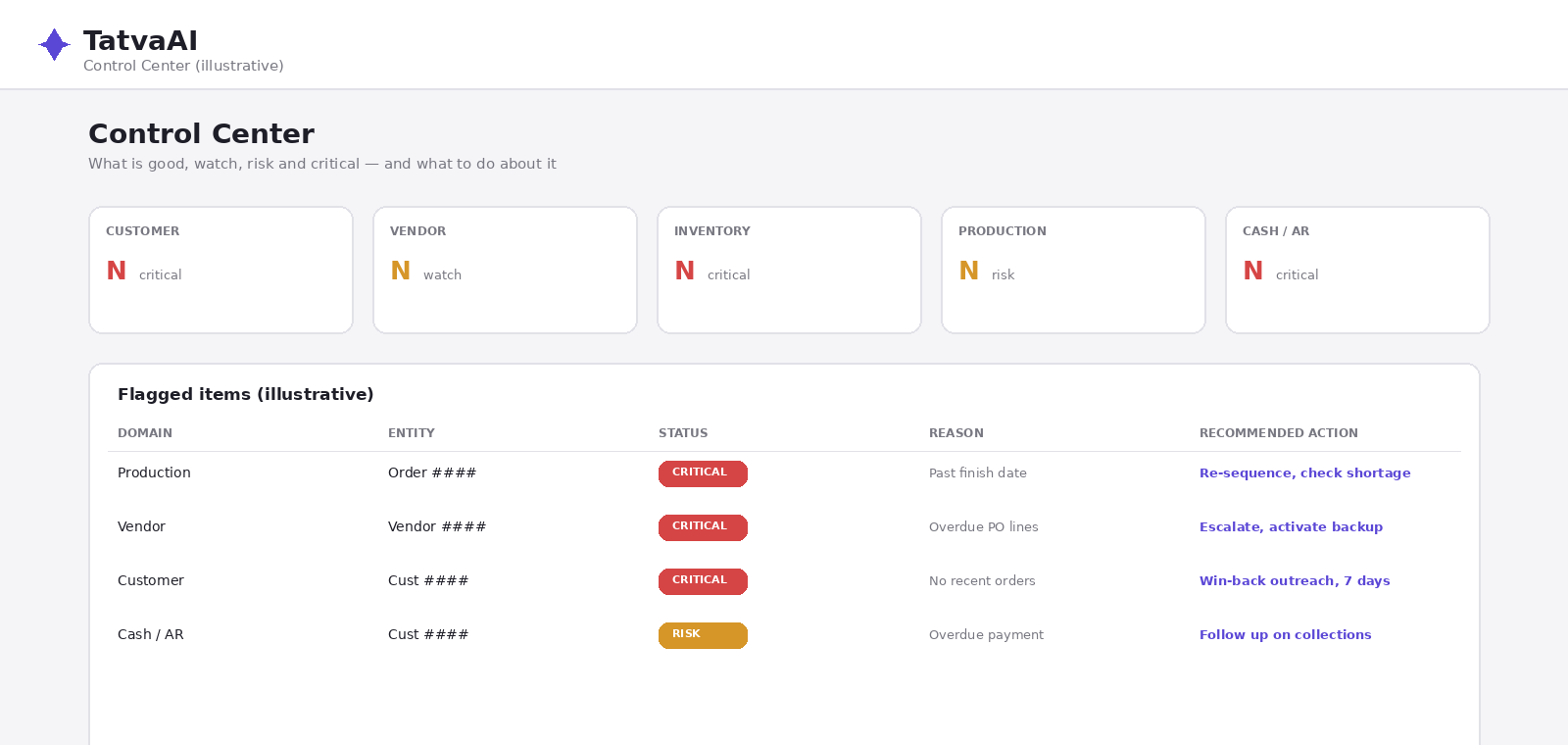
Risk in a business rarely stays contained to one department. A vendor delay can cause a production slip, which can cause a customer to churn, which eventually shows up as a cash flow problem. TatvaAI's Control Center is designed around this reality, consolidating risk monitoring across customer, vendor, inventory, and cash into a single daily view.
Customer Risk Monitoring
Customer risk typically centers on order activity and revenue trends — flagging customers who have gone quiet after a history of regular business, or whose recent revenue has dropped sharply. Early detection here allows a win-back outreach before the relationship is fully lost.
Vendor Risk Monitoring
Vendor risk usually centers on delivery reliability — tracking overdue purchase order value and the number of overdue lines. Left unaddressed, vendor risk directly threatens production schedules and, eventually, customer commitments.
Inventory Risk Monitoring
Inventory risk covers both shortages (materials with low coverage relative to demand) and excess (stock tying up cash unnecessarily). Both extremes carry a cost, so inventory monitoring aims to keep stock levels in a healthy middle range.
Cash / AR Risk Monitoring
Cash and receivables risk focuses on overdue payments, unapplied cash, and revenue concentration in customers who may be at risk of churning. Since cash flow is often the most immediate constraint on a business, this domain tends to carry high visibility.
Why Monitoring All Four Together Matters
Because these domains are connected, a single Control Center view lets teams see the full chain of cause and effect — for example, noticing that a vendor delay (Vendor domain) correlates with a production order slipping (Production domain), which may eventually affect revenue from a key customer (Customer domain).
Practical Use Case
A general manager reviewing the Control Center each morning can quickly assess whether today's biggest risk sits with a customer, a vendor, inventory, or cash — and allocate their attention accordingly, rather than reviewing four separate departmental reports.
FAQ
Q1: Why monitor customer, vendor, inventory, and cash together?
Because risk in one domain often causes risk in another.
Q2: What does customer risk usually indicate?
Reduced order activity or a sharp revenue drop from a regular customer.
Q3: What does vendor risk usually indicate?
Overdue purchase order deliveries.
Q4: What are the two types of inventory risk?
Shortage (low coverage) and excess (tied-up cash).
Q5: Who benefits most from this consolidated view?
General managers and operations leaders needing a daily risk overview.
Related content
Is this article helpful?
Help us improve our articles.