
How TatvaAI Builds Sales Forecasts from ERP Data
Updated 8/31/20262 min read
Forecasting only works well when it's grounded in real historical data, refreshed regularly, and transparent about its own accuracy. This article looks at how TatvaAI approaches sales forecasting.
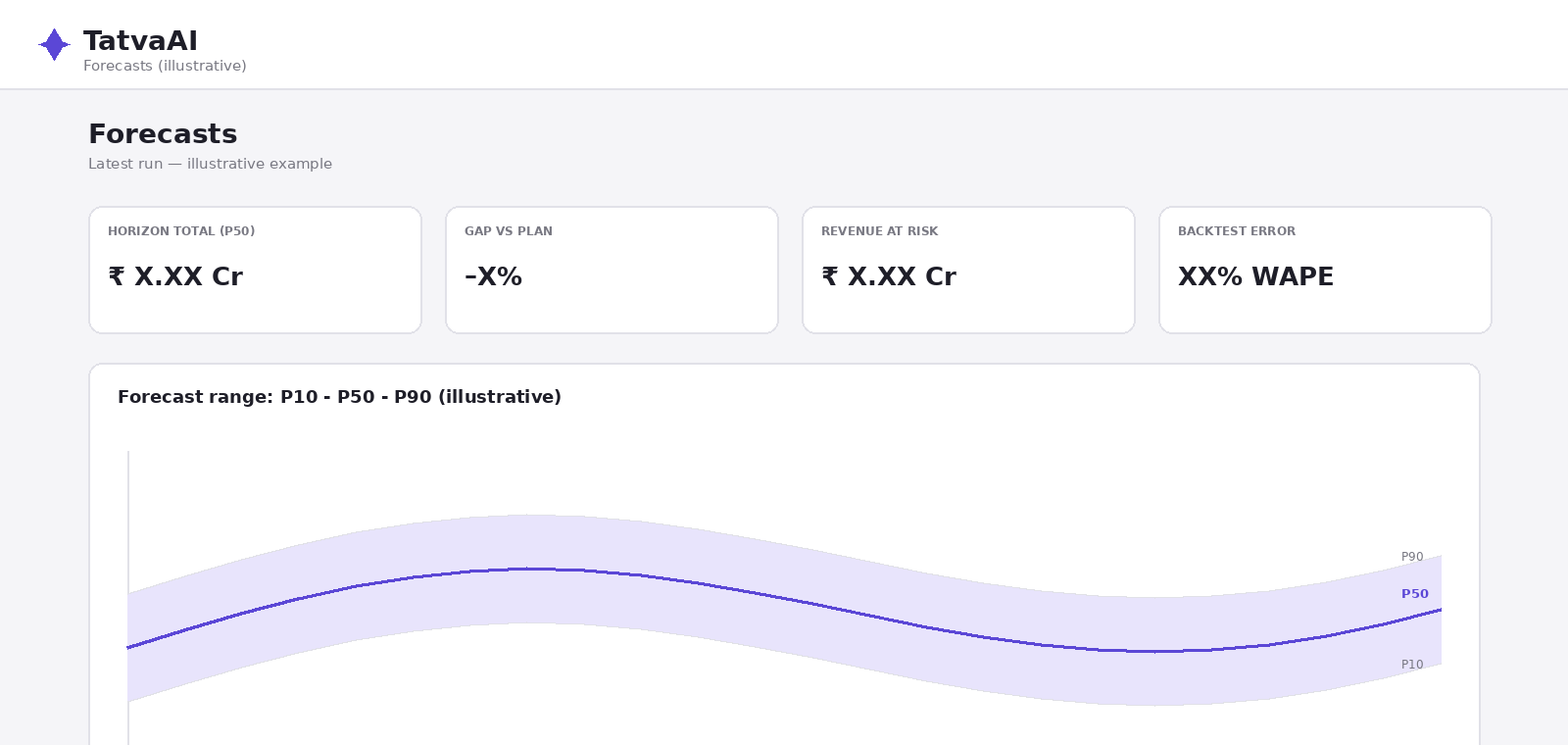
Historical Data as the Foundation
TatvaAI's forecasts are built from historical sales data already sitting in the connected ERP system — order history, revenue by time period, and relevant business dimensions such as sales organization, sales office, channel, or product group. This grounding in real transactional history is what allows the forecast to reflect genuine patterns rather than guesswork.
Forecasts by Business Dimension
Rather than producing just one company-wide number, TatvaAI can break a forecast down by dimension — such as by Sales Org, Sales Office, Channel, or Product Group — allowing different parts of the business to see forecasts relevant to their own area of responsibility.
Running a Forecast
Forecasts are generated on demand ("Run forecast now") or on a refresh schedule, with the latest run date always visible. This means forecasts stay current with the latest available ERP data rather than relying on stale historical assumptions.
What "Already in the Order Book" Means
For near-term forecast periods, TatvaAI can show what percentage of the forecast is already backed by confirmed orders sitting in the order book, versus the portion that is still purely statistical. A forecast where a large share is "already in the order book" carries more certainty than one that is entirely statistical.
Practical Use Case
A sales operations analyst runs a fresh forecast at the start of each month, reviews it broken down by Sales Office, and flags any office where the forecast is trending sharply below last year's actuals for closer follow-up with regional managers.
FAQ
Q1: What data is a TatvaAI forecast based on?
Historical sales and revenue data from the connected ERP system.
Q2: Can forecasts be broken down by business unit?
Yes, typically by Sales Org, Sales Office, Channel, or Product Group.
Q3: How often can forecasts be refreshed?
On demand, or on a regular refresh schedule.
Q4: What does "already in the order book" mean?
The portion of the forecast already backed by confirmed orders, versus purely statistical projection.
Q5: Who typically reviews forecasts?
Sales operations analysts and finance/planning teams.
Related content
Is this article helpful?
Help us improve our articles.