
Spot Customers Who Stopped Ordering with TatvaAI
Updated 8/31/20262 min read
One of the costliest risks in any business is a good customer quietly going silent — no complaints, no explanation, just no more orders. By the time this is noticed manually, it's often too late for a simple win-back. TatvaAI's Control Center is built to catch this early.
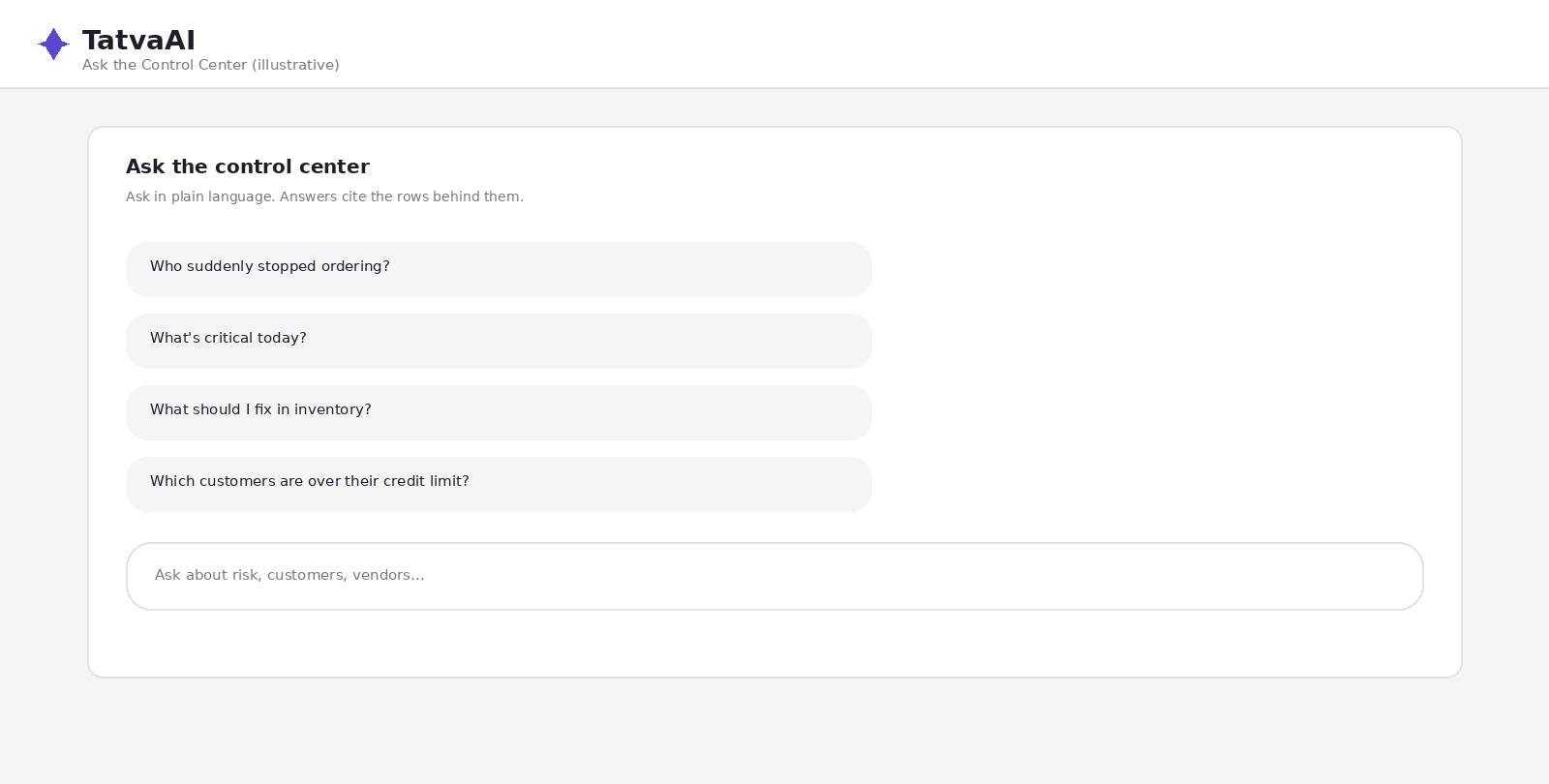
How TatvaAI Flags Silent Customers
The Control Center's customer domain flags entities showing a pattern such as significant revenue over the trailing 12 months but no recent order activity. This combination — historical value plus a sudden stop — is a strong early signal that a customer relationship needs attention.
The Recommended Action
When a customer is flagged this way, TatvaAI typically recommends a specific next step, such as a win-back outreach within a defined window (for example, 7 days), along with a check for open returns or complaints — since unresolved service issues are a common reason customers quietly stop ordering.
Asking Directly
Rather than browsing the flagged table, a sales or customer success lead can simply ask the Control Center "who suddenly stopped ordering?" and get a focused list of exactly these customers, ranked by the revenue at stake.
Why Speed Matters Here
The earlier a silent customer is caught, the more likely a win-back outreach succeeds — before they've fully switched to a competitor or resolved their need elsewhere. Automating this detection removes the delay that comes from manually reviewing order history account by account.
Practical Use Case
A customer success manager runs this check every Monday morning, asking "who suddenly stopped ordering?" and reaching out personally to the top few flagged accounts by revenue at stake — turning a reactive process into a proactive, weekly habit.
FAQ
Q1: How does TatvaAI detect a silent customer?
By combining historical revenue value with a lack of recent order activity.
Q2: What action is usually recommended?
A win-back outreach within a set window, plus a check for unresolved complaints.
Q3: How do I ask about this directly?
Ask the Control Center "who suddenly stopped ordering?"
Q4: Why does early detection matter?
Because win-back attempts are more likely to succeed before a customer fully switches away.
Q5: How often should this check be run?
Regularly, such as weekly, to catch new cases early.
Related content
Is this article helpful?
Help us improve our articles.