
One Platform Beats Five Separate Tools
Updated 9/16/20264 min read
Your sales team closes a deal. Good news, right? But the delivery team doesn't find out until three days later, buried in an email someone forgot to forward. At the same time, HR is trying to find someone free to work on the new project. But that information sits in a different system, and nobody has updated it in weeks. By the time everyone is on the same page, you've already lost a week.
If this sounds familiar, it's not because your team is doing something wrong. It's because most companies run on tools that were never built to talk to each other. And that gap is starting to cost businesses more time and money than people realize.
AI is now part of the work, not just a chatbot on the side.
For a while, "AI" at work meant a chatbot you could ask a question. It gave you an answer, but it didn't actually do anything.
That's changing. More companies are now using AI agents that work inside the tools people already use every day—for HR, sales, and projects. For example, an AI agent could write the first draft of a performance review. Or it could notice a deal has gone quiet and remind the salesperson to follow up. Or it could reassign tasks automatically when a project starts falling behind, instead of waiting for someone to notice in a meeting.
This is useful, but it also comes with responsibility. The best companies don't just turn these features on and forget about them. They keep people informed about what the AI is doing. They make sure a human checks anything important, especially decisions about hiring or performance. This also matches what new laws like the EU AI Act expect from companies using AI in HR decisions. Even without the law, it's simply fair—people deserve to know when AI played a part in a decision about them.
Why using many separate tools is a problem
For years, the common advice was, "Don't use one big platform; pick the best individual app for each job." Best CRM. Best HR tool. Best project tool. Then connect them all together.
The problem is that every connection point can break. An integration stops working, and no one notices for a week. Someone renames a field in one tool, and it stops matching the other tool. A customer's details get updated in the CRM, but the support team is still looking at the old version. None of these are huge disasters on their own. But together, they waste a lot of time and cause a lot of confusing conversations.
This is why more businesses are choosing a unified platform instead—one system where everything is connected. A deal closes in the Sales CRM, and a project can start automatically, already assigned to the right people. An update in your HRMS shows up immediately in workforce planning, instead of sitting unread in a spreadsheet. A custom dashboard shows sales, projects, and team workload all in one screen—because it really is one system, not five different tabs pretending to be one.
This is also why more companies care about skills mapping now. When your HR data and project data live in the same place, you can quickly see who on your team already has the right skills for a new project. You don't have to guess, and you don't have to start a slow, expensive hiring search every single time.
What this looks like with Hoicko
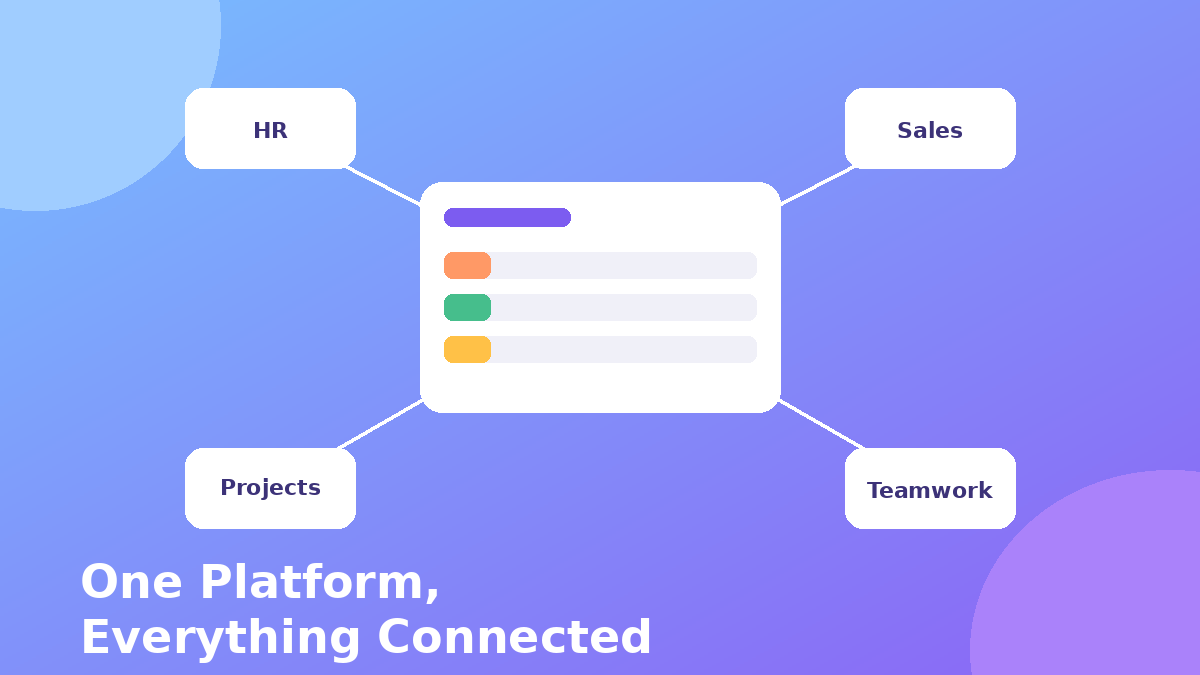
This is exactly the problem Hoicko solves. Instead of giving you another separate app to manage, Hoicko brings HR, sales, projects, and teamwork into one connected system.
- Hoicko HRMS — manage your team from hiring to performance reviews, all in one place
- Sales CRM — see your deals and customers clearly, and share that view with more than just the sales team
- Workflow & Automation — turns one action, like closing a deal, into the next step automatically, like starting a project or sending a notification
- Collaboration & Custom Dashboards — one shared view of what's happening across your whole business, updated in real time
- Dev & Digital Signature — bring the tools you'd normally manage separately into the same system
The goal isn't to add more software. It's to remove the data silos that quietly waste your team's time every day, so everyone works from the same true information instead of five slightly different versions of it.
The simple takeaway
The businesses that do well won't necessarily be the ones using the most tools. They'll be the ones with the fewest gaps between their tools—where closing a deal, starting a project, and finding the right person to work on it all feel like one smooth process, not three separate steps someone has to connect by hand.
AI will keep getting better and more useful in daily work. But AI is only as good as the data and systems it's connected to. If your HR, sales, and project information still live in separate places, that's the first thing worth fixing.
Want to see what a connected HRMS, CRM, and workflow platform looks like? Explore Hoicko's products or check out Workflow Automation and Custom Dashboards.
Is this article helpful?
Help us improve our articles.