
Forecast Exceptions & Revenue at Risk in TatvaAI
Updated 8/31/20262 min read
Not every part of a forecast deserves equal attention. TatvaAI highlights "exceptions" — forecast series that deviate significantly from expectations — so planners can focus their review time where it matters most.
What Counts as an Exception
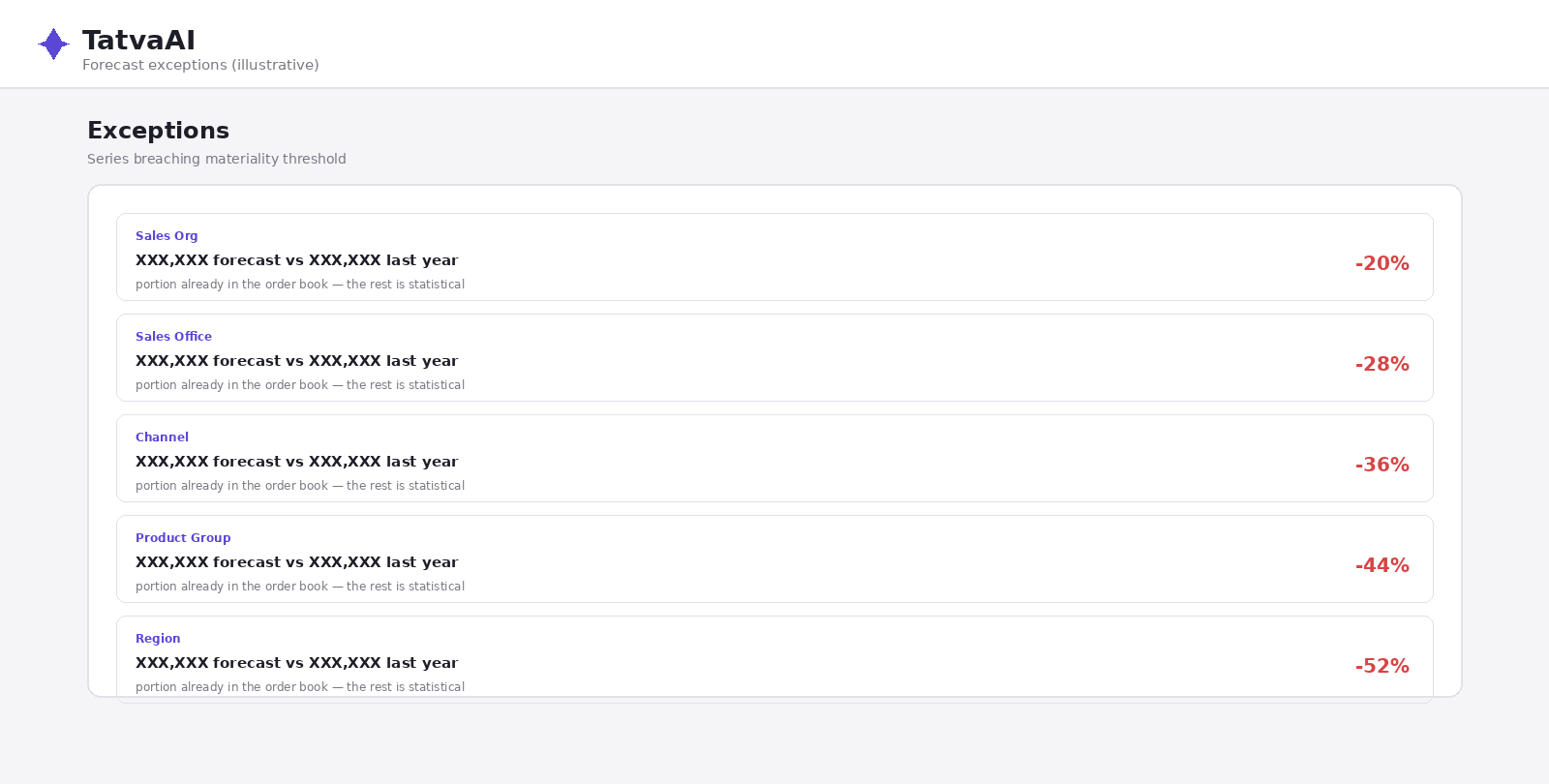
An exception is typically a forecast series that breaches a defined materiality threshold — for example, a percentage deviation from last year's actuals large enough to be flagged for review, rather than dismissed as normal variance.
Reading an Exception Entry
Each exception entry typically shows the forecast dimension (such as a specific Sales Org or Channel), the forecast value against last year's comparable figure, the percentage change, and how much of that forecast is already backed by confirmed orders versus purely statistical.
What "Revenue at Risk" Means
Revenue at risk represents the portion of forecast revenue tied to areas showing meaningful uncertainty or downside deviation — a useful number for finance leaders assessing how much of the plan could be affected if current trends continue.
Why Backtest Error Matters
Alongside the forecast itself, TatvaAI shows a backtest error metric (such as median WAPE — weighted absolute percentage error), which measures how accurate past forecasts have been against actual results. A high backtest error is a signal to treat the current forecast with more caution, and to dig deeper into why past predictions have been less reliable for that particular series.
Practical Use Case
A finance team reviewing 25 flagged exception series prioritizes the ones with both the largest revenue at stake and the largest percentage deviation, focusing their limited planning-cycle time on the handful of series most likely to affect the overall plan.
FAQ
Q1: What is a forecast exception?
A forecast series that deviates significantly from expectations, past a materiality threshold.
Q2: What does an exception entry typically show?
The dimension, forecast value, comparison to last year, and percentage change.
Q3: What does "revenue at risk" mean?
The portion of forecast revenue tied to areas of meaningful uncertainty.
Q4: What is backtest error?
A measure of how accurate past forecasts have been against actual results.
Q5: How should exceptions be prioritized?
By combining size of revenue at stake with size of deviation.
Related content
Is this article helpful?
Help us improve our articles.